
Mouse Droppings vs Rat Droppings: How to Tell Which You Have
Droppings are usually the first sign of a rodent problem, and their size, shape and pattern tell you whether you are dealing with mice or rats.
Most homeowners find droppings long before they see the animal itself. In Lewisham Council’s guidance, almost 95% of rodent sightings in the home are mice, yet rats still turn up in kitchens, lofts and gardens across South London. Health matters too: the UK Health Security Agency recorded 154 cases of leptospirosis in England in 2024, up from 138 the year before.
This guide explains how to tell the two apart, what else the droppings can tell you, and how to clean them up safely. If you already know it is mice, our mice control service covers homes and businesses across Bexley and South London.
What Is the Difference Between Mouse and Rat Droppings?
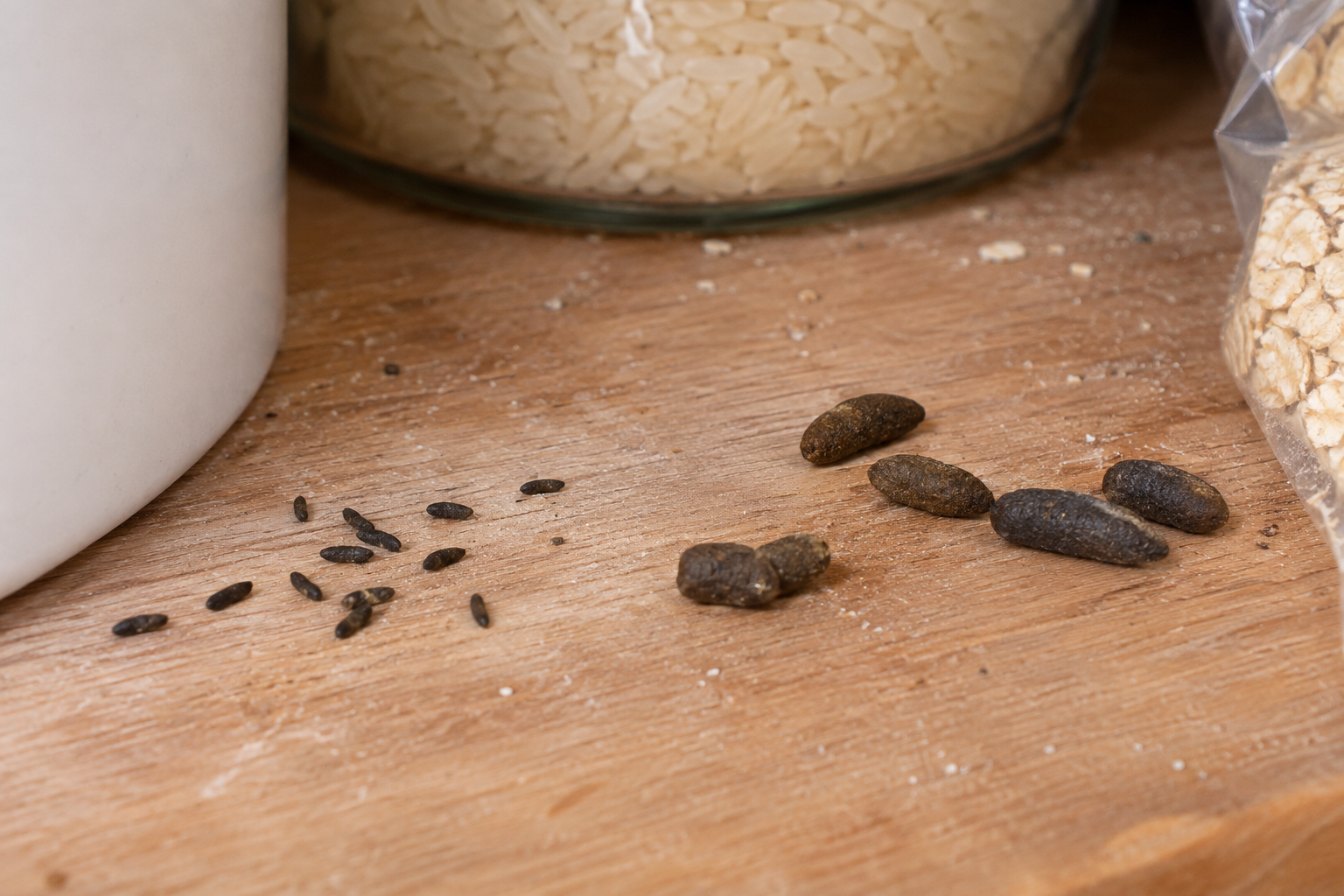
The main difference is size: mouse droppings are a few millimetres long, while rat droppings are several times bigger. Shape, number and how they are spread around add to the picture. Put those clues together and you can usually tell which rodent you have within a minute.
Size
Lewisham Council describes mouse droppings as rod shaped and 3 to 6 mm long, about the size of a grain of rice. Rat droppings are around 20 mm long. If you can cover a dropping with a grain of rice, it is almost certainly from a mouse.
Shape and Colour
Mouse droppings are thin, black and usually pointed at one or both ends. Rat droppings are thicker and spindle shaped, and the same guidance compares them to baked beans or raisins. Both are dark when fresh, although the colour of rat droppings can vary with diet.
Quantity and Pattern
How the droppings are spread out is one of the most useful clues. The two species behave very differently here, as the points below show.
- Mice: large numbers of small droppings, scattered along runs, shelves and the backs of cupboards.
- Rats: fewer but larger droppings, usually left together in groups in one or two spots.
- Both: droppings collect most heavily near food, nesting material and the routes the animals use every night.
What Do Mouse Droppings Look Like?
Mouse droppings look like small, dark grains of rice, roughly 3 to 6 mm long, and they are almost always scattered rather than piled. A mouse with access to food can defecate every 10 minutes, according to Lewisham Council. That is why even a small mouse problem leaves a lot of droppings behind.
Where Mouse Droppings Usually Turn Up
Mice stay close to food and shelter, so their droppings follow the same pattern. These are the places to look first.
- Kitchen cupboards: along the back edge of shelves, inside drawers and under the sink.
- Behind appliances: under the fridge, cooker and washing machine, where they find warmth.
- Lofts and eaves: on insulation and stored boxes, often near the edges of the roof space.
- Skirting boards: mice run along walls, so droppings gather along the edges of rooms.
Mouse Droppings in the Loft
Droppings on loft insulation are a common find in autumn, when mice move indoors for warmth. Our guide to finding where mice get into your loft explains how to trace their route in. Finding the gap matters as much as dealing with the mice already inside.
What Do Rat Droppings Look Like?
Rat droppings are dark brown or black, spindle shaped and around 20 mm long, about the size of a raisin. They are normally found in small groups rather than scattered one by one. Finding even a handful indoors is a sign to act quickly.
Where Rats Leave Their Droppings
Rats use regular routes and tend to leave droppings along them. These are the most common places to find them.
- Gardens and sheds: under decking, behind compost bins and along fence lines.
- Under the kitchen sink: where pipes pass through walls and floors.
- Lofts and wall cavities: rats can climb, so droppings in the roof space are not always from mice.
- Garages and outbuildings: near stored pet food, bird seed or rubbish.
Why Size Can Mislead You
Young rats leave smaller droppings than adults, so a few small droppings do not always mean mice. If the droppings are grouped together and vary in size, a young rat is a possibility. When in doubt, our rat control team can identify the species during an inspection.
How Can You Tell Fresh Droppings From Old Ones?
Fresh droppings are dark, shiny and soft, while old droppings are dry, dull and crumble when pressed with a stick. Knowing the age tells you whether the rodents are still active. It also helps you judge whether a treatment is working.
A Simple Test
Clean the area thoroughly, then check it again after a few days. New droppings mean the rodents are still visiting that spot. No new droppings may mean an old problem, although rodents sometimes change their route rather than leave.
Other Signs to Look For
Droppings rarely appear on their own. It is worth checking for these signs nearby.
- Gnaw marks: on food packaging, skirting boards, cables and pipes.
- Smear marks: dark, greasy lines along walls where rodents brush past.
- Noises: scratching or scurrying in the loft, walls or under floors at night.
- Nests: shredded paper, fabric or insulation tucked into a quiet corner.
Could the Droppings Be From Another Animal?
Yes, droppings from squirrels and some insects are sometimes mistaken for rodent droppings. Checking the size, shape and location usually rules them in or out. If you are unsure, a photo next to a coin is a useful thing to show a technician.
Squirrel vs Rat Droppings
Squirrel droppings are found mostly in lofts and are rounder and more barrel shaped than rat droppings. Squirrels in the roof space are also noisier during the day, while rats are more active at night. Our squirrel control service deals with grey squirrels in lofts and eaves.
Cockroach vs Mouse Droppings
Cockroach droppings are much smaller than mouse droppings and look like ground black pepper or coffee grounds. They tend to collect in warm spots such as behind the fridge or around boilers. If that sounds familiar, see our cockroach control page.
Can Mouse or Rat Droppings Make You Sick?
Yes, rodent droppings and urine can carry bacteria that cause illness, so they should never be handled with bare hands. The Health and Safety Executive explains that leptospirosis, also called Weil’s disease, is caught from the urine of infected rats. The bacteria can enter through cuts and scratches or through the lining of the mouth, throat and eyes.
How to Clean Up Droppings Safely
The aim is to avoid touching the droppings and avoid stirring up dust. These steps keep the job as safe as possible.
- Protect yourself: wear rubber gloves and keep cuts covered.
- Do not sweep or vacuum dry droppings: this lifts dust into the air you breathe.
- Dampen first: spray the droppings with household disinfectant and leave them to soak for a few minutes.
- Wipe and bag: pick them up with paper towels, seal them in a bag and put it in your outside bin.
- Finish off: disinfect the surface again, then wash your hands thoroughly, even after wearing gloves.
When to Leave It to a Professional
Large amounts of droppings in a loft, under floors or in a food business are better handled by a trained technician. Our team holds Level 2 certification and is fully licensed and insured. We clear the problem safely and deal with the cause as well.
What Should You Do After Finding Droppings?
Once you know whether you have mice or rats, the next step is to stop more coming in and deal with the ones already inside. The two jobs go together. Treating the rodents without sealing the entry points usually means they come back.
Why Getting the Species Right Matters
Mice and rats behave differently, so the treatment differs too. Lewisham Council notes that rats range 50 to 100 metres while mice stay within 1.5 to 5 metres of their nest. I spent 9 years at Rentokil before starting Pest2Control, and identifying the right species is still the first thing I check on every visit.
Sealing the Way In
Oxford City Council notes that mice can get into homes through gaps as small as 6 mm. Common entry points include gaps around pipes, air bricks, damaged brickwork and the edges of doors. Our rodent proofing service finds and seals these gaps so the problem does not return.
How Our Treatment Works
We can give you an estimate over the phone, then start with an on-site inspection to find the species, the activity and the entry points. Treatment runs as a 3-visit programme, so we can check progress and adjust. We cover homes in Eltham, Bromley and the rest of Bexley and South London, including evenings and weekends.
Rat versus mice droppings comes down to a few simple checks: size, shape, number and where you find them. Small, scattered, rice-sized droppings point to mice, while larger, grouped droppings around 20 mm long point to rats. Fresh, dark droppings mean the rodents are still active.
Whatever you find, clean it up safely and look for the gap they are using. If you would like a second opinion, our team can inspect your property and put a plan in place. Every job comes with our satisfaction guarantee.
FAQ
Are rat droppings bigger than mouse droppings?
Yes, adult rat droppings are around 20 mm long, while mouse droppings are only 3 to 6 mm. Young rats leave smaller droppings, so look at the pattern as well as the size.
How many droppings does a mouse leave?
A mouse with access to food can defecate every 10 minutes, so a single mouse leaves dozens of droppings a day. This is why mouse droppings are usually found in large, scattered numbers.
Is it safe to vacuum mouse droppings?
It is best not to vacuum or sweep dry droppings, because this can lift dust into the air. Dampen them with disinfectant first, then wipe them up with paper towels while wearing gloves.
Can I have rat droppings but no rats in the house?
Yes, droppings in a garden, shed or under decking can mean rats are living outside without coming indoors yet. It is still worth acting early, because rats often move inside as the weather turns colder.
What should I do if I find droppings in my loft?
Check the size and pattern to work out whether they are from mice, rats or squirrels. Then look for entry points around the eaves and roof line, and call a professional if the droppings are fresh or widespread.