
Mouse Proofing in Bexley: Why Mice Get In and How to Stop Them
Every year, UK local authority pest control teams handle around 80,000 call-outs for mice, according to the British Pest Control Association, and Greater London accounts for a large share of them. Britain’s house mouse population is estimated at around 5.2 million, and every autumn a good number of them start looking for somewhere warmer to spend the winter, often a house in Bexley, Bexleyheath, Sidcup or Welling.
If you’ve heard scratching in the loft, found droppings behind the kettle or noticed a gnawed corner on a bag of dog food, you’re not imagining it. Mice don’t appear from nowhere. They find a gap in the building, follow it inside, and once they’ve found warmth and food, they stay and breed. The good news is that every one of those gaps can be found and sealed. That’s the difference between chasing mice out every few months and stopping them getting in at all.
At Pest 2 Control, we survey properties across Bexley and the wider South London area every week, and the pattern is consistent: older housing stock, a handful of overlooked structural gaps, and a mouse that only needed six millimetres to get through. Here’s what we find, and what a proper proofing job actually involves.
Why Bexley’s Housing Stock Makes This Worse
A large share of homes across Bexley, Bexleyheath and Sidcup date from the interwar and Victorian periods, built with solid or early cavity wall construction, timber suspended ground floors, and ventilation designed decades before pest exclusion was ever a consideration. Many of these properties have cavity walls, two layers of blockwork with a gap running between them. Once a mouse gets into that cavity anywhere along the wall, it has a corridor running around the entire building, which is why mice can turn up in an upstairs bedroom with no obvious entry point nearby.
Add in decades of small building work, extensions, replaced guttering and new soil pipes, and each job tends to leave a small unsealed gap where a wall meets a pipe or a roofline meets brickwork. On their own, none of these gaps look like much. Together, they add up to a property with several possible entry points that nobody has ever thought to check.
How Small a Gap Does a Mouse Actually Need
A fully grown mouse can squeeze through an opening around 6 to 7mm wide, roughly the width of a pencil, and a young mouse needs even less. If you can push a biro through a gap in your brickwork or around a pipe, treat it as an open door.
The Entry Points We Find Most Often in Bexley Homes
Air Bricks, Vents and Pipework
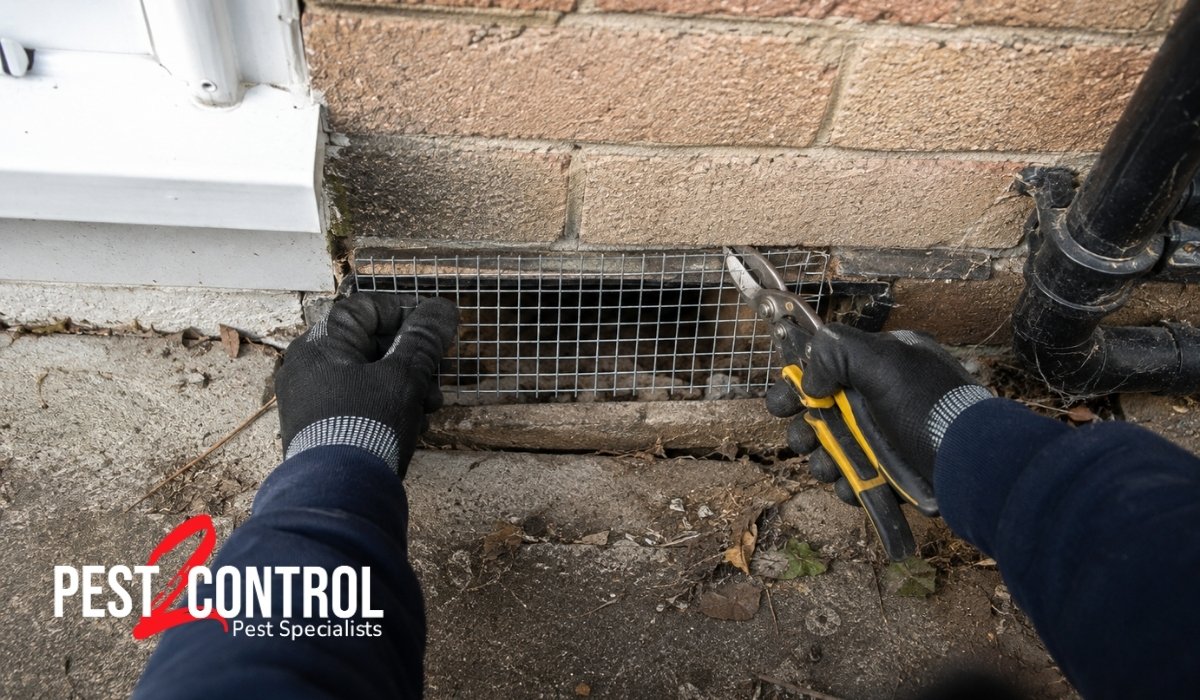
- Air bricks without a mesh guard fitted, a direct route into suspended timber floors
- Gaps around waste, gas and water pipes where they pass through an outside wall
- Unsealed vents and extractor fan outlets at ground and wall level
Brickwork, Doors and Outbuildings
- Cracked or missing pointing in older brickwork, especially around bay windows and chimney breasts
- Worn seals and ill fitting doors on garages, sheds and older external doors
- Gaps where an extension or conservatory joins the original structure
Roofline and Cable Entry Points
- Loose roof tiles and gaps at the soffits and fascia, giving mice a route straight into the loft
- Cable and pipe entry points at the meter box, or where broadband and satellite cables were drilled through a wall
These same gaps are just as attractive to rats. If you’re hearing something heavier than scratching, or seeing larger droppings, our rat control service covers the same entry points and the same proofing principles.
Signs Mice Are Already Inside
Proofing stops new mice getting in, but it’s worth knowing the signs of an existing problem too, since sealing entry points before dealing with mice already inside just traps them in the building. Look out for:
- Scratching or scurrying sounds in the loft, walls or under floors, usually after dark
- Droppings: small, dark and rice shaped, often found along skirting boards or near food
- Gnaw marks on food packaging, cables, timber or stored cardboard
- Greasy smear marks along skirting boards and pipe runs, left by fur brushing the same routes repeatedly
- A persistent musty, ammonia-like smell that doesn’t shift with ventilation
Why Bait Boxes and DIY Fixes Rarely Solve It
We’re regularly called to a property a few months after the homeowner has put down their own bait boxes. The mice already inside are dealt with, but new ones move in behind them because the gap that let the first lot in was never found. Bait and traps treat the mice that are already there. They do nothing about the ones still on their way in.
Expanding foam and loose wire wool aren’t much better on their own. Mice can chew through foam within days, and wire wool that isn’t properly secured eventually works loose. It’s the difference between a temporary patch and a permanent fix.
What Proper Rodent Proofing Involves
The Survey
A thorough rodent proofing job starts with a full inspection of the property, inside and out, checking every point where mice are known to get in. Our Level 2 certified technicians look at air bricks, drainage, roofline, pipework and any recent building work to build a complete picture before any sealing begins.
The Materials We Use
Each entry point is sealed with the right material for the job. That might mean stainless steel mesh over an air brick, proofing mortar around a pipe, or a metal kick plate on a door with a worn edge. As BPCA members, we work to the standard the industry sets for this exact job, not a quick patch a mouse can chew straight through.
Why Autumn Is the Moment to Act
As temperatures drop, mice move indoors looking for warmth, food and shelter, and they don’t need much of an invitation. Getting a property proofed before the weather turns means those gaps are already closed before the annual rush starts, rather than after the scratching has already begun.
Mice don’t get into Bexley homes by chance. They follow a gap that was always there, usually one nobody has ever thought to check. Sealing it properly, rather than just dealing with the mice currently inside, is what actually stops the problem coming back year after year. If your property hasn’t been checked for entry points, now, before the cold weather sets in, is the time to get it done.
Frequently Asked Questions
Every property is different, so we assess the number and type of entry points during a survey before quoting. Get in touch for an accurate estimate for your home.
No. Part of a proper proofing survey is checking for signs of an existing infestation first. If mice are already inside, we clear them before sealing external entry points, so nothing gets trapped in.
Most residential proofing jobs are completed in a single visit, though larger or older properties with more entry points can take longer.
Prevention is far cheaper and less disruptive than dealing with an established infestation. If your property is older or has had building work done, it’s worth a check even without visible signs yet.
Our mice control service deals with an existing infestation. Rodent proofing seals the entry points that let mice in, in the first place. Most jobs involve both: clearing the current problem, then proofing so it doesn’t return.